
Technical Contents
Engineering Guide: Ames Industrial

Engineering Insight: The Critical Role of Material Selection in Industrial Rubber Applications
In the realm of industrial rubber solutions, material selection is not merely a design consideration—it is a foundational engineering decision that directly impacts performance, safety, and total cost of ownership. At Suzhou Baoshida Trading Co., Ltd., we observe a recurring challenge among OEMs and maintenance engineers: the reliance on off-the-shelf rubber components that appear functionally adequate but fail prematurely under real-world operating conditions. These failures often stem from a mismatch between base polymer properties and the specific mechanical, thermal, and chemical environments of the application.
Standard rubber parts are typically formulated for general-purpose use, prioritizing cost-efficiency over performance resilience. However, industrial environments—such as those in mining, petrochemical processing, or heavy machinery—demand materials engineered to withstand extreme variables. For instance, exposure to ozone, UV radiation, hydraulic fluids, or continuous dynamic stress can rapidly degrade generic elastomers like natural rubber (NR) or standard nitrile (NBR). The consequences include cracking, swelling, loss of tensile strength, and ultimately, system downtime.
A precision-engineered rubber compound begins with a thorough analysis of application parameters: temperature range, media compatibility, compression set requirements, abrasion resistance, and dynamic loading. At Baoshida, we leverage advanced polymer science to tailor formulations using materials such as hydrogenated nitrile (HNBR), fluorocarbon (FKM), ethylene propylene diene monomer (EPDM), and specialty polyurethanes (PU). Each offers distinct advantages under targeted conditions, enabling long-term reliability where commodity rubbers fail.
Consider a hydraulic sealing application in a high-temperature oil environment. An off-the-shelf NBR seal may function initially but will degrade rapidly above 100°C or in contact with modern synthetic hydraulic fluids. In contrast, an FKM-based solution maintains integrity up to 200°C and exhibits superior resistance to oils, fuels, and many acids.
The table below outlines key performance characteristics of common industrial elastomers:
| Material | Temperature Range (°C) | Oil/Fuel Resistance | Abrasion Resistance | Key Applications |
|---|---|---|---|---|
| NBR | -30 to +100 | Good | Moderate | General seals, O-rings |
| HNBR | -40 to +150 | Excellent | High | Automotive, oilfield |
| FKM | -20 to +200 | Outstanding | Moderate | Aerospace, chemical |
| EPDM | -50 to +150 | Poor | Moderate | Water/steam, HVAC |
| PU | -30 to +85 | Good | Exceptional | Rollers, wear parts |
Material selection is not a one-size-fits-all proposition. It requires collaboration between material scientists, design engineers, and end users to ensure compatibility with operational demands. Off-the-shelf solutions often overlook these nuances, resulting in unplanned maintenance and reduced equipment lifespan. By investing in application-specific rubber formulations, OEMs achieve not only enhanced performance but also improved lifecycle economics.
At Baoshida, we specialize in translating industrial challenges into engineered rubber solutions—where precision, durability, and compatibility are non-negotiable.
Material Specifications

Industrial Rubber Material Specifications: Viton, Nitrile, Silicone
Suzhou Baoshida Trading Co., Ltd. provides precision-engineered rubber compounds for critical industrial applications. Selecting the optimal elastomer requires rigorous analysis of operational parameters including temperature extremes, chemical exposure, and mechanical stress. Below we detail the technical specifications for three foundational materials: Viton (FKM), Nitrile (NBR), and Silicone (VMQ). Each formulation undergoes stringent ASTM D2000 testing to ensure compliance with OEM performance thresholds.
Viton fluoroelastomers deliver exceptional resistance to high temperatures, aggressive chemicals, and fuels. Standard grades maintain integrity from -20°C to 250°C continuous service, with specialty variants extending to 300°C. Viton exhibits superior stability against aromatic hydrocarbons, acids, and jet fuels, making it indispensable for aerospace seals, chemical processing gaskets, and semiconductor manufacturing components. Its primary limitation involves poor resistance to ketones and organic acids, alongside higher material costs compared to hydrocarbon rubbers.
Nitrile butadiene rubber remains the industry standard for oil and fuel resistance in cost-sensitive applications. Operating effectively between -40°C and 120°C, NBR formulations demonstrate robust tensile strength (15-30 MPa) and abrasion resistance. It is the preferred choice for hydraulic seals, automotive fuel systems, and industrial O-rings exposed to mineral oils, greases, and aliphatic hydrocarbons. Critical constraints include vulnerability to ozone degradation, limited high-temperature performance beyond 120°C, and reduced flexibility below -40°C without specialized low-temperature grades.
Silicone rubber excels in extreme temperature cycling from -60°C to 230°C while maintaining electrical insulation properties. Its inert composition provides biocompatibility per USP Class VI and ISO 10993 standards, supporting medical device and food-grade applications. Silicone resists oxidation and weathering but exhibits lower tensile strength (5-10 MPa) and poor resistance to concentrated acids, alkalis, and steam. Common uses include pharmaceutical tubing, high-voltage insulators, and extreme-environment seals where compression set resistance is critical.
The following table summarizes key comparative specifications for engineering validation:
| Property | Viton (FKM) | Nitrile (NBR) | Silicone (VMQ) |
|---|---|---|---|
| Temperature Range (°C) | -20 to 250 | -40 to 120 | -60 to 230 |
| Tensile Strength (MPa) | 10-20 | 15-30 | 5-10 |
| Key Resistances | Fuels, Acids, Ozone | Oils, Greases, Water | Heat, Cold, UV |
| Critical Limitations | Ketones, Esters | Ozone, High Temp | Acids, Steam, Tear |
| Primary Applications | Aerospace, Chemical | Automotive, Hydraulics | Medical, Electrical |
Material selection must account for dynamic service conditions beyond baseline specs. Suzhou Baoshida’s OEM engineering team validates formulations against actual application profiles, including fluid immersion testing per ASTM D471 and compression set analysis at elevated temperatures. Custom compound adjustments—such as carboxylated NBR for enhanced wear resistance or peroxide-cured silicone for low-compression set—are available to meet exacting industrial requirements. Always consult application-specific testing data before final material qualification.
Manufacturing Capabilities
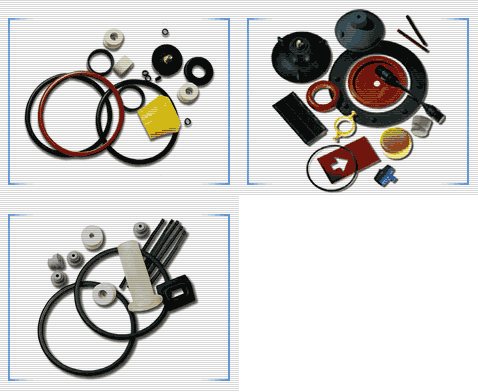
Engineering Capability
At Suzhou Baoshida Trading Co., Ltd., our engineering capability forms the backbone of our industrial rubber manufacturing excellence. With a dedicated team of five certified mould engineers and two advanced formula engineers, we deliver precision-driven, application-specific rubber solutions tailored to the demanding requirements of global OEMs. Our integrated engineering approach ensures seamless development from concept to production, maintaining strict adherence to performance, durability, and dimensional accuracy standards.
Our mould engineering team specializes in the design and optimization of complex rubber moulds for compression, transfer, and injection moulding processes. Utilizing advanced CAD/CAM software including SolidWorks, AutoCAD, and UG NX, our engineers perform detailed 3D modelling, tolerance analysis, and flow simulation to ensure optimal material distribution and minimal cycle times. Each mould design undergoes rigorous validation through prototype testing and finite element analysis (FEA), guaranteeing long service life and consistent part quality under industrial operating conditions.
Complementing our mould expertise, our two in-house rubber formulation engineers bring deep materials science knowledge to every project. They develop custom compound formulations tailored to specific environmental and mechanical requirements, including resistance to oil, ozone, high temperatures, and dynamic stress. By controlling the entire formulation process—from raw material selection to vulcanization parameters—we ensure repeatability, regulatory compliance, and superior performance across batches. Our formulation lab is equipped for comprehensive testing, including hardness, tensile strength, elongation, compression set, and thermal aging, in accordance with ASTM and ISO standards.
Suzhou Baoshida is a trusted OEM partner, providing end-to-end manufacturing solutions under strict confidentiality and IP protection protocols. We support low-volume prototyping through high-volume production, with scalable manufacturing lines capable of producing up to 500,000 units per month. Our OEM clients benefit from design for manufacturability (DFM) feedback, rapid tooling turnaround (typically 15–25 days), and full documentation packages including material certifications, process FMEAs, and PPAP submissions.
The synergy between our mould and formula engineering teams enables us to solve complex sealing, damping, and wear challenges across industries such as automotive, heavy machinery, energy, and industrial automation. Whether developing a high-temperature silicone gasket or an oil-resistant NBR diaphragm, our engineering-first philosophy ensures that every component meets the exact functional demands of the application.
| Specification | Capability |
|---|---|
| Mould Engineers | 5 (CAD/CAM, FEA, DFM) |
| Formula Engineers | 2 (Polymer Chemistry, Testing) |
| Mould Types Supported | Compression, Transfer, Injection |
| Software Platforms | SolidWorks, AutoCAD, UG NX |
| Monthly Production Capacity | Up to 500,000 units |
| Material Testing Standards | ASTM D2000, ISO 3302, ISO 2768 |
| Typical Tooling Lead Time | 15–25 days |
| OEM Services | Full DFM, PPAP, IP Protection, Batch Traceability |
This robust engineering infrastructure positions Suzhou Baoshida as a strategic partner for industrial clients requiring technically advanced, high-reliability rubber components delivered with manufacturing precision.
Customization Process

Customization Process for Industrial Rubber Components
At Suzhou Baoshida Trading Co., Ltd., our engineering-driven customization process ensures industrial rubber solutions meet exact OEM specifications while optimizing performance and cost-efficiency. We execute a rigorous four-phase workflow beginning with Drawing Analysis. Here, our technical team dissects client CAD files and engineering drawings to validate dimensional tolerances, surface finishes, and functional requirements against material science constraints. Critical parameters such as compression set limits, fluid resistance, and dynamic stress points are cross-referenced with ISO 3302 and ASTM D2000 standards. This phase identifies potential manufacturability risks early, preventing costly revisions downstream.
Formulation follows, where our rubber chemists develop compound recipes tailored to operational environments. We select base polymers—NBR for oil resistance, EPDM for ozone stability, or FKM for extreme temperatures—then engineer additive packages for cure kinetics, abrasion resistance, and thermal aging. Each formulation undergoes computational modeling to predict vulcanization behavior and mechanical properties, ensuring alignment with the client’s fatigue life and chemical exposure requirements. Material certifications, including REACH and FDA compliance, are documented at this stage.
Prototyping validates theoretical models through physical iteration. Using client-approved tooling, we produce small-batch samples for laboratory and field testing. Key metrics like tensile strength, elongation at break, and compression deflection are measured per ASTM D412 and D395. Clients receive detailed test reports with failure mode analysis; if results deviate from targets, we refine the compound or process parameters within 72 hours. This agile iteration loop guarantees the final prototype achieves >98% functional accuracy before scaling.
Mass Production leverages our ISO 13485-certified manufacturing network. We implement Statistical Process Control (SPC) on critical dimensions, with real-time monitoring of cure time, temperature, and pressure. Every batch undergoes 100% visual inspection and randomized destructive testing against the approved prototype. Traceability is maintained via serialized lot coding, ensuring full accountability from raw material to shipment. Our lean production system achieves <0.5% defect rates while accommodating volume scalability from 1,000 to 500,000 units monthly.
The following table summarizes critical parameters controlled across phases:
| Phase | Key Parameters Monitored | Target Tolerance | Testing Standard |
|---|---|---|---|
| Drawing Analysis | Dimensional GD&T, Material Hardness Range | ±0.1mm | ISO 1101 |
| Formulation | Cure Time (t90), Tensile Strength (MPa) | ±5% | ASTM D5289, D412 |
| Prototyping | Compression Set (%), Fluid Swell (%) | ±3% | ASTM D395, D471 |
| Mass Production | Hardness (Shore A), Batch-to-Batch Consistency | ±2 points | ASTM D2240, SPC Charts |
This systematic approach minimizes time-to-market while guaranteeing components withstand demanding industrial applications. Suzhou Baoshida’s integration of material science rigor and precision manufacturing delivers rubber solutions engineered for operational longevity.
Contact Engineering Team

Contact Suzhou Baoshida Trading Co., Ltd. for Advanced Industrial Rubber Solutions
Suzhou Baoshida Trading Co., Ltd. stands at the forefront of industrial rubber formulation and OEM manufacturing, delivering precision-engineered elastomeric components tailored to the rigorous demands of global industrial clients. With over a decade of experience in rubber compounding, material testing, and custom molding processes, we specialize in providing high-performance sealing, damping, and insulation solutions across automotive, aerospace, energy, and heavy machinery sectors. Our technical team leverages advanced polymer science and state-of-the-art production capabilities to ensure every product meets exacting standards for durability, chemical resistance, and thermal stability.
For AMES Industrial and other strategic partners seeking reliable, scalable, and technically superior rubber components, direct engagement with our lead engineer and OEM manager, Mr. Boyce, ensures seamless collaboration from concept to mass production. Mr. Boyce brings extensive expertise in rubber-to-metal bonding, custom compound development, and failure mode analysis, enabling proactive design optimization and rapid prototyping. Whether your application requires fluorocarbon (FKM), silicone (VMQ), ethylene propylene diene monomer (EPDM), or specialty hydrogenated nitrile (HNBR), our formulation lab can engineer materials to meet specific hardness, compression set, and fluid resistance requirements.
We operate under strict ISO 9001:2015 quality management protocols, with in-house capabilities including injection molding, compression molding, and transfer molding, supported by comprehensive QC instrumentation such as Shore hardness testers, tensile strength analyzers, and thermal aging chambers. Our supply chain is optimized for just-in-time delivery without compromising traceability or batch consistency.
To initiate a technical consultation or request a material datasheet, contact Mr. Boyce directly at [email protected]. He will guide you through our application review process, provide feasibility assessments, and support DFMEA documentation for integration into your production workflow. For time-sensitive inquiries, please include your preferred contact hours and technical specifications to accelerate response time.
Below is a summary of our core rubber material capabilities for reference:
| Material Type | Hardness Range (Shore A) | Temperature Range (°C) | Key Resistance Properties | Common Applications |
|---|---|---|---|---|
| Nitrile (NBR) | 40–90 | -30 to +100 | Oil, fuel, abrasion | Seals, O-rings, gaskets |
| Fluorocarbon (FKM) | 50–90 | -20 to +200 | High heat, chemicals, oils | Automotive turbo systems, aerospace |
| Silicone (VMQ) | 30–80 | -55 to +180 | UV, ozone, extreme cold | Electrical insulation, medical devices |
| EPDM | 45–85 | -40 to +135 | Steam, water, weathering | HVAC, automotive cooling systems |
| HNBR | 50–95 | -40 to +150 | High pressure, dynamic stress | Oil & gas downhole tools |
Partner with Suzhou Baoshida to leverage data-driven rubber engineering and responsive OEM support. Reach out to Mr. Boyce today to discuss your next-generation industrial solution.
⚖️ O-Ring Weight Calculator
Estimate rubber O-ring weight (Approx).