

Rubber Products
Rubber Moulds
We have our own mould manufacturing workshop and experienced structural design engineers, so we can independently design and develop rubber moulds rather than pass the work on.
View product →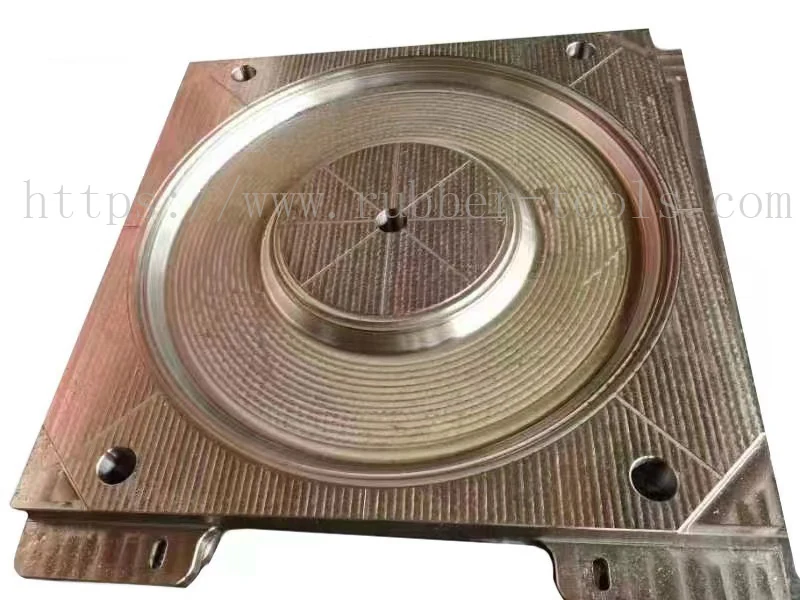
The moulding process decides tooling cost, cycle time and how much detail a part can carry. Choosing it is a commercial decision as much as a technical one.
Compression moulds are suited to larger parts with simpler designs. A measured charge of compound is placed in the cavity and the tool closes on it. Tooling is comparatively simple and therefore cheaper, cycle times are longer, and fine detail and tight flash control are harder to hold. For low to medium volumes of a chunky part it is frequently the right economic answer.
Transfer moulds are the choice for intricate designs and over moulding applications, including parts where rubber is moulded onto an insert. The compound is forced from a pot into the cavity, which gives better detail and better control around inserts than compression does, at higher tooling cost.
Custom Moulded Rubber From Drawing to Production →
Injection gives the shortest cycles and the best repeatability at volume, with the highest tooling cost to match. Where a part runs in large annual quantities, the tooling premium is recovered quickly in cycle time and scrap rate. For plastic parts we work with three plastic production suppliers under our own inquiry, quality control and delivery supervision.
Volume and geometry decide it. A large simple part at modest volume points to compression. A detailed part or one with a metal insert points to transfer. A high volume part with tight repeatability points to injection. We will tell you which we would tool and why, including when the cheaper tool is the better commercial decision for your quantity.
A mould designed by a shop that will never run it optimises for ease of cutting rather than for ease of moulding. Our five mould structural engineers design the tool, our own workshop builds it, and our three rubber process engineers run it, so parting line, flash and cure problems are solved by the people who created them.
We have our own mould manufacturing workshop and experienced structural design engineers, so we can independently design and develop rubber moulds rather than pass the work on.
View product →
An O-ring mould decides whether every ring coming off it is the same.
View product →
We have three plastic production suppliers, and we handle the inquiry, the quality control and the delivery supervision ourselves.
View product →
Where our plastic parts line makes a defined part, this line starts earlier, from a requirement rather than a finished drawing.
View product →We will tell you with the quotation, along with the reasoning, because the answer depends on your geometry and annual volume.
Yes. We have our own machining workshop and coating workshop, so the metal part and the bonded rubber both come from us.
Yes. We can design and manufacture a variety of moulds and tools, and whether the tool stays with us or ships to you is agreed before we start.
Send the size, the medium and the quantity, and we will apply exactly the reasoning in this guide to your part.